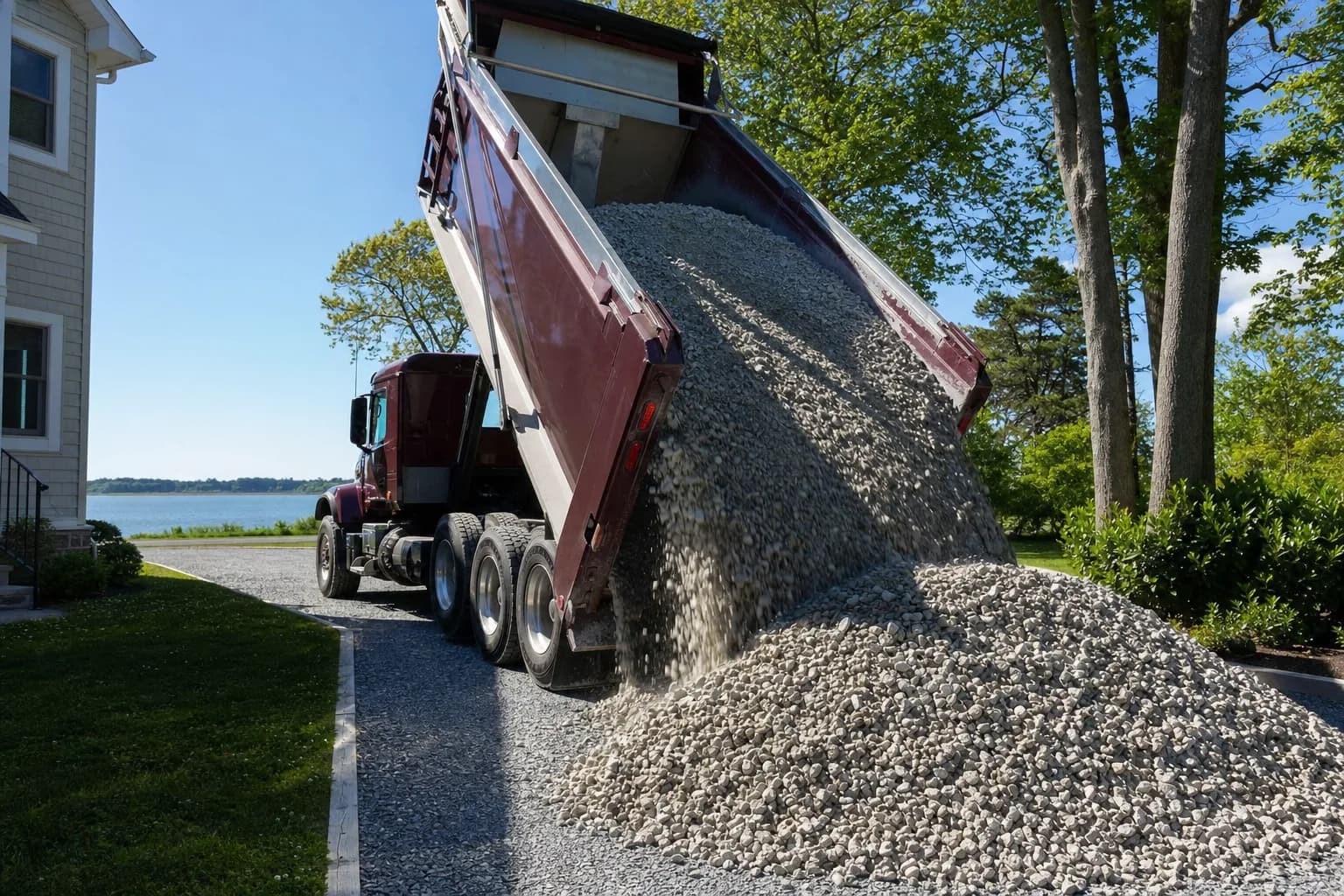
Gravel Delivery Sized to the Ground You Actually Have
Crushed stone, river rock, topsoil & more, with delivery in as fast as 2 business days.


Why Choose Maryland Rock Supply
Aggregate materials for homeowners and contractors across Maryland
Aggregate Materials
Stone, rock, soil, and related bulk materials.
Per-Ton Pricing
Review the per-ton price before placing your order.
FREE Bulk Delivery
Get free dump truck delivery throughout Maryland, with delivery possible in as fast as 2 business days.
Customer Support
Get order support through phone, email, or text.
Aggregate delivery across Maryland
Free delivery across Maryland, including Baltimore, Columbia, Silver Spring, Waldorf and Frederick.
Stone commonly used in Maryland includes limestone, granite and marble. Orders are delivered by dump truck to jobs from the Chesapeake Bay, the Eastern Shore and the Piedmont, with delivery included in the price.
Common projects here include CR-6 driveways, shoreline riprap and yard drainage. Piedmont clay on the west side, coastal-plain sand on the Eastern Shore. Bay-adjacent work also runs into critical-area rules that limit impervious surface. Frost goes to about 30 inches in Maryland, so plan base depth around it.
What we call it in Maryland
If your project follows an engineering or road-agency spec, compare it with the size and grading listed on each product page.
Popular delivery areas in Maryland
- Baltimore
- Frederick
- Gaithersburg
- Rockville
- Bowie
- Hagerstown
- Annapolis
- College Park
- Salisbury
- Laurel
- Greenbelt
- Hyattsville
- Westminster
- Cumberland
- Aberdeen
- Takoma Park
- Easton
- Elkton
- Havre De Grace
- Cambridge
- La Plata
- Bel Air
- Mount Airy
- Bladensburg
Every Maryland city we deliver to, A to Z · Gravel delivery across Maryland · All counties and cities we serve
Quickly Calculate How Much You Need

Straightforward Ordering
Select Your Material
Look through our catalogue for a material suited to your project.
Work Out Your Quantity
Our calculator helps estimate the gravel amount to order.
Place Your Order for Delivery
Enter your details, and we'll bring the order to your door.
A lane in Garrett County sits on thin, stony soil over shale and siltstone, with the county code putting frost at 36 inches. A few hours east, a lot in Anne Arundel County sits on unconsolidated sand, silt and clay a short distance above tidal water. Both owners want gravel delivery, and both will type roughly the same phrase into a search box, but the stone that holds up under one of those drives rutted or washed out under the other long before anyone blamed the material. The catalogue on this site is arranged by what the ground is doing, not by what photographs well.
Three jobs bring most people here. Each has a material underneath and a material on top, and they are rarely the same product.
A drive that rutted through a wet spring: base first, surface second
Ruts are usually a base problem wearing a surface problem's clothes. The compacted layer under a Maryland drive is CR-6, a 1 inch minus graded blend of crushed stone, gravel and binding fines that locks up dense once it is rolled damp. Four to six inches of it, built in lifts and crowned so storm water runs off the edges, is the working range for a drive that sees cars and the occasional delivery van.
What goes over it depends on the finish. Driveway Gravel at 3/4 inch gives a crushed surface that compacts and still lets water through. #57 Stone gives a washed, angular top layer with no fines in it.
Crusher Run is a separate product here, 3/4 inch minus, not another name for CR-6. Order it where a slightly finer compacting layer suits the job.
Ground changes the depth more than the traffic does. Central Piedmont silt loam goes soft when it is saturated and stays that way for days, so the base has to bridge it. On low Coastal Plain ground the base has to sit above the wet rather than in it.
Water standing in the yard two days after a nor'easter
Summer thunderstorms, nor'easters and tropical storm rain all soak the same flat, low ground near the Bay and the tidal rivers, and that ground sheds water slowly. The answer is a clean washed stone with the fines taken out of it, so water moves through the voids instead of sitting in them.
#57 Stone and Drain Rock are the two that belong in a French drain, a drywell, a downspout run or a foundation drain, laid 12 inches deep or more. A 3/8 inch pea gravel suits a shallow splash bed under a downspout where the look matters as much as the drainage.
The common mistake is reaching for a blend that contains dust. Screenings, the material Maryland yards call stone dust, is a bedding layer under pavers and flagstone. Put it in a trench and it silts the drain closed.
A bank or shoreline losing ground to the Chesapeake
Wave action and storm tides work at Bay and tidal river shorelines, and stream bank scour does the same inland after heavy rain. RipRap at 4 to 12 inches and up is the armor layer, set in courses at least 12 inches thick over a separation fabric, sourced from a landscape supplier rather than here. Large River Rock at 2 to 4 inches settles into a dry channel or a water feature edge where the work is decorative rather than structural.
One planning note before anything is measured. Inside the Chesapeake and Atlantic Coastal Bays Critical Area, the band within 1,000 feet of tidal waters and tidal wetlands, a lot has a cap on how much of it may be covered. There is no single statewide figure: 15 percent in a Limited Development Area, stricter again in a Resource Conservation Area, with each county running its own program. It reaches a page about stone because lot coverage explicitly counts gravel, stone, shell, pavers and permeable pavement, so a parking pad counts against the allowance. Confirm yours with the county Critical Area program before widening a drive.
Turning a measured pad into tons before anything is ordered
Area times depth, then two divisions. Length times width in feet gives square feet; depth in inches divides by 12 to become feet; multiply, then divide by 27 for cubic yards.
Take a parking pad of 22 by 16 feet at 5 inches of compacted base as an example. That is 352 square feet. Five inches is 0.4167 feet, so 352 times 0.4167 comes to 146.7 cubic feet, and 146.7 divided by 27 is 5.4 cubic yards. At the weight this site publishes for the crusher run and road base family, about 1.50 tons per cubic yard and approximate, that pad needs close to 8.1 tons.
The material calculators run the same arithmetic for all 24 products, each with its own weight, and hand back cubic yards, tons and cubic feet.
Booking gravel delivery once the drop spot is chosen
Ordering happens on the product page: pick the tonnage, pick a delivery date, and enter the ZIP code that decides delivery at checkout.
The load comes off in a pile, so put the pile where the wheelbarrow run is shortest, and what the truck needs to get there covers the approach, the clearance and marking the spot.
Measure first, run the numbers, then browse the catalogue and set a date. If the access is tight or the job crosses two layers, the contact page is the faster route, the answers page collects what most buyers ask next, and who is behind the storefront sets out what happens after checkout.
Gravel Questions and Answers
Answers about our materials and services
Have any questions?
We can help estimate quantities, choose gravel for the job, and set up a delivery schedule that suits you.
Contact us